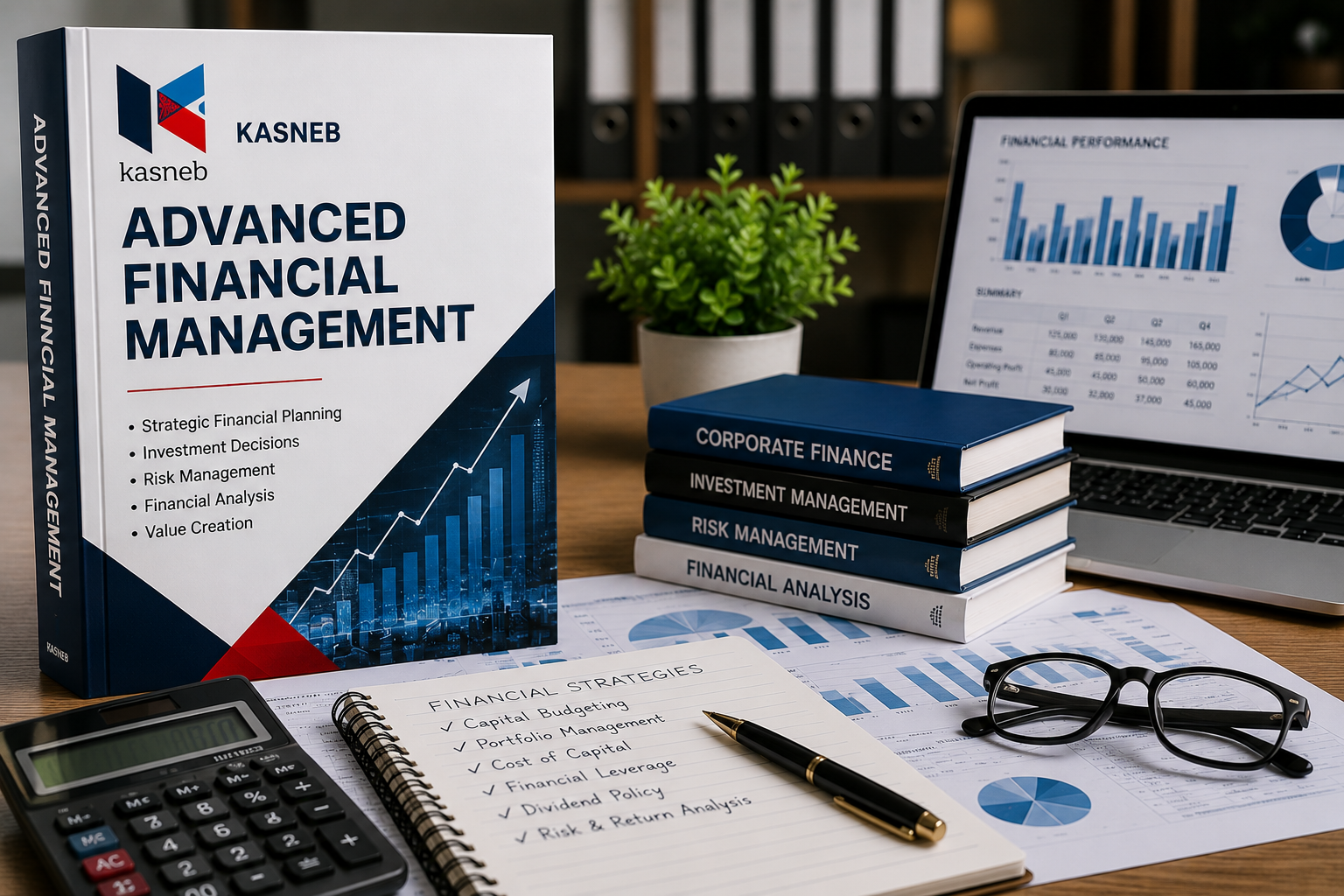
CA33 Advanced Financial Management

- 8 Sections
- 70 Lessons
Join Live Zoom Class
Topic 1
- Financial Management and Corporate Objectives
- 7TH SEP: A RECAP OF WHAT WAS COVERED IN INTERMEDIATE 2 (DAY CLASS BY MR. NYAMU)
- 8TH SEP : SUBTOPIC - RECAP OF CAPITAL BUDGET(MR. GITHINJI, DAY CLASS)
- 8TH SEP TOPIC: ADVANCED CAPITAL BUDGETING(MR. NYAMU, EVENING CLASS)
- 12TH SEP SUBTOPIC: SENSITIVITY ANALYSIS (MR. NYAMU,EVENING CLASS)
- 14TH SEP SUBTOPIC: SCENARIO ANALYSIS (MR. NYAMU, EVENING CLASS)
- 14TH SEP SUBTOPIC: METHODS OF HANDLING RISKS AND UNCERTAINTY (MR. GITHINJI,DAY CLASS)
- 15TH SEP SUBTOPIC: SIMULATION ANALYSIS DECISION TREE
- 16TH SEP SENSITIVITY ANALYSIS
- 19TH SEP SUBTOPIC: DECISION TREE( MR. NYAMU,EVENING CLASS)
- 20TH SEP(MAKE UP CLASS)- MR. NYAMU,EVENING CLASS
- 21ST SEP MON(DAY CLASS) BY MR. GITHINJI- SUBTOPIC: SCENARIO ANALYSIS
- CAPITAL BUDGETING NOTES PART 1-MR GITHINJI
- 21ST SEP MON(EVENING CLASS) BY MR. NYAMU -SUBTOPIC: CAPITAL RATIONING,SINGLE PERIOD RATIONING WITH DIVISIBLE PROJECTS
- 22ND SEP TUE(DAY CLASS) BY MR. GITHINJI - SUBTOPIC: SIMULATION ANALYSIS
- 23RD SEP WED( EARLY MORNING AND EVENING CLASS FOR 22ND SEP) BY MR. NYAMU- SUBTOPICS: SINGLE INDIVISIBLE, MULTIPLE PERIOD RATIONING
- 23RD SEP WED(DAY CLASS) BY MR. GITHINJI - SUBTOPICS: DECISION TREES,CAPITAL RATIONING
- 26TH SEP SAT (DAY CLASS) BY MR. NYAMU - SUBTOPIC: PROJECTS WITH UNEQUAL LIVES
- 28TH SEP MON( DAY CLASS) BY MR. GITHINJI - SUBTOPIC - CAPITAL RATIONING
- 28TH SEP MON(EVENING CLASS) BY MR. NYAMU - SUBTOPIC: REAL OPTIONS IN CAPITAL BUDGETING
- 29TH SEP TUE(EARLY MORNING CLASS) BY MR. NYAMU - SUBTOPIC: REAL OPTIONS IN CAPITAL BUDGETING,ABANDONMENT OPTION
- 29TH SEP TUE( DAY CLASS) BY MR. GITHINJI - SUBTOPIC: PROJECTS OF UNEQUAL LIVES
- 29TH SEP TUE(EVENING CLASS) BY MR. NYAMU - SUBTOPIC: REPLACEMENT ILLUSTRATION
- 30TH SEP WED(EARLY MORNING CLASS) BY MR. NYAMU - SUBTOPIC: REPLACEMENT OPTION
- 30TH SEP WED(DAY CLASS) BY MR. GITHINJI - SUBTOPIC: REPLACEMENT CYCLE,INFLATION
- 3RD OCT SAT(EVENING CLASS) BY MR. NYAMU - TOPIC: ADVANCED CAPITAL BUDGETING DECISIONS.PORTFOLIO THEORY AND ANALYSIS
- 5TH OCT MON(DAY CLASS) BY MR. GITHINJI - TOPIC : CAPITAL BUDGETING
- 5TH OCT MON(EVENING CLASS) BY MR. NYAMU - SUBTOPIC: RISK MEASUREMENT,ASSETS PORTFOLIO
- 6TH OCT TUE(EARLY MORNING CLASS) BY MR. NYAMU - TOPIC: PORTFOLIO THEORY AND ANALYSIS
- 6TH OCT TUE(DAY CLASS) BY MR. GITHINJI - TOPIC: PORTFOLIO THEORY
- 6TH OCT TUE(EVENING CLASS) BY MR. NYAMU - SUBTOPIC: 3 ASSETS PORTFOLIO,MEAN VARIANCE DOMINANCE RULE
- 7TH OCT WED (EARLY MORNING CLASS) BY MR. NYAMU - SUBTOPIC: THREE ASSET PORTFOLIO,MEAN- VARIANCE,DOMINANCE ROLE
- 7TH OCT WED(EARLY MORNING CLASS) BY MR. NYAMU - SUBTOPIC: 3 ASSETS PORTFOLIO,MEAN VARIANCE DOMINANCE RULE PRT 2
- 7TH OCT WED(DAY CLASS) BY MR. GITHINJI - TOPIC: PORTFOLIO THEORY
- 10TH OCT SAT(EVENING CLASS) BY MR. NYAMU - SUBTOPIC: DERIVATION OF EFFICIENT PORTFOLIO,THEMES OF PORTFOLIO
- 10TH OCT SAT(EVENING CLASS) BY MR. NYAMU - SUBTOPIC: PORTFOLIO THEORY (CONTINUATION)
- 12TH OCT MON(DAY CLASS) BY MR. GITHINJI - SUBTOPIC: RISK REDUCTION AND MINIMUM RISK PORTFOLIO
- 12TH OCT MON(EVENING CLASS) BY MR. NYAMU - SUBTOPIC:ILLUSTRATIONS ON CAPITAL ASSETS PRICING MODE
- 13TH OCT TUE(EARLY MORNING CLASS) BY MR. NYAMU - SUBTOPIC: CAPITAL ASSET PRICING MODEL(CAPM) APRIL 2026 Q 5B
- 13TH OCT TUE(DAY CLASS) BY MR. GITHINJI - SUBTOPIC: PORTFOLIO SELECTION
- 13TH OCT TUE( EVENING CLASS) BY MR. NYAMU - SUBTOPIC:FAMA FRENCH MODEL
- 14TH OCT WED( EARLY MORNING CLASS) BY MR. NYAMU - SUBTOPIC: ARBITRAGE PRICING THEORY(APT)
- 14TH OCT WED(DAY CLASS) BY MR. GITHINJI - SUBTOPIC: CAPITAL MARKET LINE
- 17TH OCT SAT(EVENING CLASS) BY MR. NYAMU - TOPIC: MERGERS AND ACQUISITION
- 18TH OCT SUN(EVENING/ EARLY MORNING CLASS) BY MR. NYAMU - MERGERS AND ACQUISITION (CONTINUATION) PRT 1
- 18TH OCT SUN(EVENING/ EARLY MORNING CLASS) BY MR. NYAMU - MERGERS AND ACQUISITION (CONTINUATION) PRT 2
- 19TH OCT MON(DAY CLASS) BY MR. GITHINJI - SUBTOPIC: CAPM AND APT
- 19TH OCT MON(EVENING CLASS) BY MR. NYAMU - TOPIC: ADVANCED FINANCING DECISIONS
- 20TH OCT TUE(EARLY MORNING CLASS) BY MR. NYAMU - ADVANCED FINANCING DECISIONS
- 20TH OCT TUE(EARLY MORNING /EVENING CLASS) BY MR. NYAMU - ADVANCED FINANCING DECISIONS
- 21ST OCT WED(EARLY MORNING CLASS) BY MR. NYAMU - SUBTOPIC: CAPITAL STRUCTURE THEORIES
- 21ST OCT WED(DAY CLASS) BY MR. GITHINJI - SUBTOPIC: CAPM AND APT
- 22ND OCT THUR(DAY CLASS) BY MR. GITHINJI - SUBTOPIC: PORTFOLIO PERFORMANCE PRT 1
- 22ND OCT THUR(DAY CLASS) BY MR. GITHINJI PRT 2
- 24TH OCT SAT( EVENING CLASS) BY MR. NYAMU - TOPIC: ADVANCED FINANCING DECISIONS
- 25TH OCT SUN(EARLY MORNING/ EVENING CLASS) BY MR. NYAMU - SUBTOPIC: 2ND, 3RD AND 4TH MM PROPOSITION
- 26TH OCT MON(DAY CLASS) BY MR. GITHINJI - SUBTOPIC: MERGERS FINANCING AND ANALYSIS
- 26TH OCT MON(EVENING CLASS) BY MR. NYAMU - SUBTOPIC: SPECIAL CASES IN FINANCING DECISIONS
- 27TH OCT TUE(EARLY MORNING CLASS) BY MR. NYAMU - SUBTOPIC: SPECIAL CASES IN ADVANCED FINANCING DECISIONS
- 27TH OCT TUE(DAY CLASS) BY MR. GITHINJI - SUBTOPIC: MERGER ANALYSIS
Topic 2
Topic 3
Topic 4
Topic 5
Topic 6
Topic 7
CA33: Advanced Financial Management equips learners with advanced knowledge and practical skills in strategic financial decision-making within both private and public sector organizations. The course builds on foundational financial management concepts by focusing on complex investment, financing, risk management, and corporate restructuring decisions in dynamic business environments.
Learners develop the ability to evaluate advanced capital budgeting projects, optimize capital structures, manage financial risks using derivative instruments, assess investment portfolios, and apply international finance principles. The course also covers mergers and acquisitions, corporate restructuring, real estate finance, business valuation, and contemporary issues affecting financial management.
Upon successful completion of the course, learners will be be able to apply advanced financial management techniques to maximize organizational value, manage financial risks effectively, and provide strategic financial advice that supports sustainable business growth and long-term organizational objectives.
CONTEXT:
- Advanced capital budgeting decision
- Incorporating risk/uncertainty in capital investment decisions
- Techniques of handling risk: Basic Methods of analysis - Expected Monetary Value (EMV), The Standard deviation and Coefficient of Variation
- Advanced Methods of analysis; sensitivity analysis, scenario analysis, decision trees, simulation analysis, utility analysis, risk adjusted discounting rate (RADR) and certainty equivalent method
- Impact of financing on investment decisions - the concept of adjusted present value (APV)
- Incorporating capital rationing in capital investment appraisal; Single period capital rationing with divisible projects; Multi-period capital rationing with divisible capital investments.
- Incorporating inflation in capital investment appraisal
- Evaluation of projects of unequal lives; The equivalent annual annuity approach and the Replacement chain analysis (Constant scale finite period replication criteria)
- Project duration as a measure of risk
- The real options in Capital Budgeting-Characteristics of the real Options; Types of Options in Capital investment Appraisal-Strategic investment option (Expansionary Option), Timing option (Option to delay a project), abandonment option (Option to Withdraw a project), the replacement option and the Option to re- deploy a project, challenges in use of options in investment analysis.
- Common capital budgeting pitfalls
- Portfolio theory and analysis
- The modern portfolio theory: background of the theory; portfolio expected return; the actual and weighted portfolio risk; derivation of efficient sets; the capital market line (CML) model and its applications, the mean variance dominance rule; short comings of portfolio theory
- Capital Asset Pricing Model-CAPM: background of the theory; assumptions; beta estimation - beta coefficient of an individual asset and that of a portfolio and the interpretation of the result; security market line (SML) model and its applications; conceptual differences between portfolio theory and capital asset pricing model; shortcomings of the CAPM
- International CAPM and Behavioural CAPM
- The Arbitrage pricing model (APM) and other multifactor models: background of the theory; conceptual differences between the Capital asset pricing model and the Arbitrage pricing model; application of the Arbitrage pricing model, shortcomings of Arbitrage pricing model; Pastor Stambaugh model
- Evaluation of portfolio performance: Treynor’s measure, Sharpe’s measure, Jensen’s measure, appraisal ratio measure, information ratio, Modigliani and Modigliani (M2)
- Advanced financing decision
- The nature of financing decision, principle objectives of making financing decision
- Analysis of breakpoints in weighted marginal cost of capital schedule (more than two breakpoints)
- Capital structure theories: nature of capital structure; factors influencing the firm’s capital structure; traditional theories of capital structure - assumptions of the theories, Net income theory and Net operating income theory; Franco Modigliani and Merton Miller’s propositions - MM without taxes, MM with corporation taxes, MM with corporation and personal tax rates and MM with taxes and financial distress costs; other theories of capital structure; the pecking order theory; Static Trade-off theory and Agency effects, determination of the firm’s optimal capital structure using the Hamada model, CAPM and WACC
- Long term financing decisions; bond refinancing decision, lease-buy evaluation and rights issues
- Assess an organisation’s debt exposure to interest rate changes using the simple
- Macaulay duration and modified duration methods
- Benefits and limitations of duration including the impact of convexity
- Mergers and acquisitions
- Nature of mergers and acquisitions
- Arguments for and against the use of acquisitions and mergers as a method of corporate expansion Acquisition and Mergers verses organic growth
- Valuation of acquisitions and mergers: problem of overvaluation; valuation models- ‘Book value-plus’ models, Market based models, cash flow models; apply appropriate methods, such as: risk-adjusted cost of capital, adjusted net present values and changing price/earnings multipliers resulting from the acquisition or merger, to the valuation process where appropriate Prediction of a takeover target: criteria for choosing an appropriate target for acquisition
- Defence tactics against hostile takeovers
- Financing of mergers and acquisitions: Outright purchase using cash, share for share exchange, share- Debenture exchange and share- preference share exchange, Analysis of combined operating profit (EBIT) and post-acquisition earning per share at the point of indifference in firm’s earnings under various financing options and Determination of range of combined operating profit within which to recommend a financing option
- Financial Evaluation of mergers and acquisitions – Post merger/Acquisition EPS, Post Merger/Acquisition MPS
- Regulatory framework for mergers and acquisitions
- Valuation of firms/ Shares for Mergers and acquisition Purposes- Use of Net asset basis, P/E ratio basis, Dividend growth model, Super profits model, Capital asset pricing Model and the Discounted free cash flow basis.
- Reasons why there are failed mergers and acquisitions
- Mergers and acquisitions in the Kenyan, regional and global context
- Corporate restructuring and re-organisation
- Background on restructuring and reorganisation
- Indicators/symptoms of restructuring
- Causes of financial distress
- Forms of financial distress and solutions to financial distress
- Considerations in designing an appropriate restructuring programme
- Financial reconstruction: forms of financial reconstruction; impact of financial reconstruction on share price; impact of financial reconstruction on the weighted Average cost of capital (WACC)
- Portfolio reconstruction: various ways of unbundling a firm: divestment, de-merger, spin-off, liquidation, sell-offs, equity curve outs, strategic alliances, management buyout, leveraged buyouts and the management buy-ins.
- The relevance of the various forms of portfolio reconstruction
- Organisational reconstruction: The nature and benefits of this form of restructuring
- Other forms of restructuring
- Restructuring in the Public sector
- Models of predicting corporate failure; Quantitative Models-Multiple discriminant analysis (Z-Score model), Springate model, Fulmer model; Qualitative Models - Argenti Model
- Financial risk management
- Types of risks: operational risks, political risks, economic risks, fiscal risks, regulatory risks, currency risks and interest rate risks
- The meaning, nature and importance of derivative instruments
- Operations of the derivatives market: The relative advantages and disadvantages of exchange traded versus over the counter (OTC) agreements; Key features, such as standard contracts, tick sizes, margin requirements and margin trading
- Types of derivatives: futures, forwards, options and swaps
- Application of option pricing theory in investment decisions: Apply the Black- Scholes Option Pricing (BSOP) model to financial product valuation and to asset valuation; assumptions, structure, application and limitations of the BSOP model; calculate and advise on the value of options to delay, expand, redeploy and withdraw using the BSOP model
- Binomial Option pricing model – Use of both riskless hedge and the risk neutral approach in Valuation of both European and American call and put options
- Foreign currency risk management: Types of forex risks, hedging currency risks, forward contracts, money market hedge, currency options, currency futures and currency swaps, Bilateral and Multilateral netting and Matching tools of managing forex risks
- Option trading Strategies- Spreads and Combinations
- Limitations of financial derivatives
- International financial management
- Introduction - The nature of international finance, Motives for investing in foreign markets and Challenges experienced by the Multinational corporations
- International financial Systems - Players in the international financial systems such as International Monetary fund, World trade organisation, European Union and the World bank.
- International trade flows and foreign direct investments(FDI)
- Financing of International Trade - Methods of financing the trade.
- International Capital and Money Markets - The foreign exchange Market- Exchange rates, Foreign Exchange exposures, International arbitrage - locational arbitrage, triangular arbitrage and covered interest arbitrage, International parity conditions- Interest rate parity, purchasing power parity and International fisher effect, International capital markets and their importance
- International Capital Budgeting - Reasons for Investing abroad, Evaluation of capital investments using local cash flows and foreign cash flows.
- International Capital structure - Factors influencing capital structure of MNCs, Sources of international finance, Cost and benefits of the alternative sources of international finance, Factors leading to difference in cost of capital of domestic firms and Multinational corporations and Adjusting WACC for risk differential
Want to submit a review? Login