CA15: Quantitative Analysis

- 10 Sections
- 55 Lessons
Join Live Zoom Class
QA COURSE OUTLINE
Topic 1
Topic 2
- Probability
- 14TH SEP: CALCULUS
- 15TH SEP : FUNCTIONS
- 20TH SEP SUN(EARLY MORNING CLASS) BY MR. KIVUVA - TOPIC: CALCULUS(DIFFERENTIATION)
- 21ST SEP MON( DAY CLASS) BY MR. KIVUVA - SUBTOPIC: APPLICATION OF DIFFERENTIATION
- 22ND SEP TUE( EARLY MORNING) BY MR. KIVUVA - SUBTOPIC: PARTIAL DIFFERENTIATION
- 22ND SEP TUE( DAY CLASS) BY MR. KIVUVA - SUBTOPIC: PARTIAL DIFFERENTIATION
- 22ND SEP TUE(DAY CLASS) BY MR. KIVUVA- CONTINUATION OF THE Q.A DAY CLASS
- 24TH SEP THUR( EARLY MORNING CLASS) BY MR. KIVUVA - SUBTOPIC: PARTIAL DIFFERENTIATION
- 24TH SEP THUR( EVENING CLASS) BY MR. KIVUVA - SUBTOPIC: PARTIAL DIFFERENTIATION
- 28TH SEP MON( DAY CLASS) BY MR. KIVUVA - SUBTOPIC ; REVIEW QUESTIONS IN CALCULUS
- 28TH SEP MON ( EVENING CLASS) BY MR. KIVUVA - SUBTOPIC: INTEGRATION REVIEW QUESTIONS
- 29TH SEP TUE ( EARLY MORNING CLASS) BY MR. KIVUVA - INTEGRATION REVIEW QUESTIONS ON CALCULUS
- 29TH SEP TUE(DAY CLASS) BY MR. KIVUVA - REVIEW QUESTIONS ON CALCULUS
- 29TH SEP TUE(DAY CLASS) BY MR. KIVUVA - TOPIC: SET THEORY
- 1ST OCT THUR (EARLY MORNING CLASS) BY MR. KIVUVA - REVIEW QUESTIONS
- 1ST OCT THUR(EVENING CLASS) BY MR. KIVUVA - REVIEW QUESTIONS ON CALCULUS
- 5TH OCT MON(DAY CLASS) BY MR. KIVUVA - TOPIC: REVIEW QUESTIONS ON SET THEORY
- 5TH OCT MON(EVENING CLASS) BY MR. KIVUVA - TOPIC: SET THEORY
- 6TH OCT TUE(EARLY MORNING CLASS) REVIEW QUESTIONS ON CALCULUS AND INTRODUCTION TO "SET THEORY
- 6TH OCT TUE(DAY CLASS) BY MR. KIVUVA - TOPIC 4: DESCRIPTIVE STATISTICS PRT 1
- 6TH OCT TUE(DAY CLASS) BY MR. KIVUVA - TOPIC 4: DESCRIPTIVE STATISTICS PRT 2
- 8TH OCT THUR(EARLY MORNING CLASS) BY MR. KIVUVA - TOPIC 3: SET THEORY
- 8TH OCT THUR(EVENING CLASS) BY MR. KIVUVA - SUBTOPIC: SET OPERATIONS, REVIEW QUESTIONS ON SET THEORY
- 11TH OCT SUN(EARLY MORNING CLASS) BY MR. KIVUVA - REVIEW QUESTIONS ON SET THEORY
- 12TH OCT MON(DAY CLASS) BY MR. KIVUVA - SUBTOPIC: MEASURES OF PARTITION PRT 1
- 12TH OCT MON(DAY CLASS) BY MR. KIVUVA - SUBTOPIC: MEASURES OF PARTITION PRT 2
- 12TH OCT MON( EVENING CLASS) BY MR. KIVUVA - SUBTOPIC;MEASURES OF DISPERSION
- 13TH OCT TUE(EARLY MORNING CLASS) BY MR. KIVUVA - TOPIC 4: DESCRIPTIVE STATISTICS
- 13TH OCT TUE(DAY CLASS) BY MR. KIVUVA - SUBTOPIC:REVIEW QUESTIONS ON DESCRIPTIVE STATISTICS,TOPIC 5: MATRIX ALGEBRA
- 13TH OCT TUE(DAY CLASS) BY MR. KIVUVA - SUBTOPIC: TYPES OF MATRICES,MATRIX OPERATIONS
- 15TH OCT THUR(EARLY MORNING CLASS) BY MR. KIVUVA - REVIEW QUESTIONS ON DESCRIPTIVE STATISTICS
- 15TH OCT THUR(EVENING CLASS) BY MR. KIVUVA - REVIEW QUESTIONS ON DESCRIPTIVE STATISTICS
- 19TH OCT MON( DAY CLASS) BY MR. KIVUVA - SUBTOPIC: SOLVING SIMULTANEOUS EQUATIONS PRT 1
- 19TH OCT MON( DAY CLASS) BY MR. KIVUVA - SUBTOPIC: SOLVING SIMULTANEOUS EQUATIONS PRT 2
- 19TH OCT MON(EVENING CLASS) BY MR. KIVUVA - SUBTOPIC: REVIEW QUESTIONS ON DESCRIPTIVE STATISTICS
- 20TH OCT TUE(EARLY MORNING/ EVENING CLASS) BY MR. KIVUVA - TOPIC: MATRIX ALGEBRA
- 22ND OCT THUR(EARLY MORNING CLASS) BY MR. KIVUVA - TOPIC: MATRIX ALGEBRA
- 22ND OCT THUR(EVENING CLASS) BY MR. KIVUVA - SUBTOPIC: SOLVING SYMOLTENEOUS QUESTIONS
- 26TH OCT MON (DAY CLASS) BY MR. KIVUVA - SUBTOPIC: SOLVING SIMULTANEUS EQUATIONS
- 26TH OCT MON(EVENING CLASS) BY MR. KIVUVA - SUBTOPIC: SOLVING SIMULTENEOUS EQUATIONS
- 27TH OCT TUE(EARLY MORNING CLASS) BY MR. KIVUVA - SUBTOPIC: SOLVING SIMULTENEOUS EQUATIONS
- 27TH OCT TUE(DAY CLASS) BY MR. KIVUVA - SUBTOPIC: MARKOV PROCESSES
- 27TH OCT TUE(DAY CLASS) BY MR. KIVUVA - SUBTOPIC: MARKOV PROCESSES PRT 2
Topic 3
Topic 4
Topic 5
Topic 6
Topic 7
Topic 8
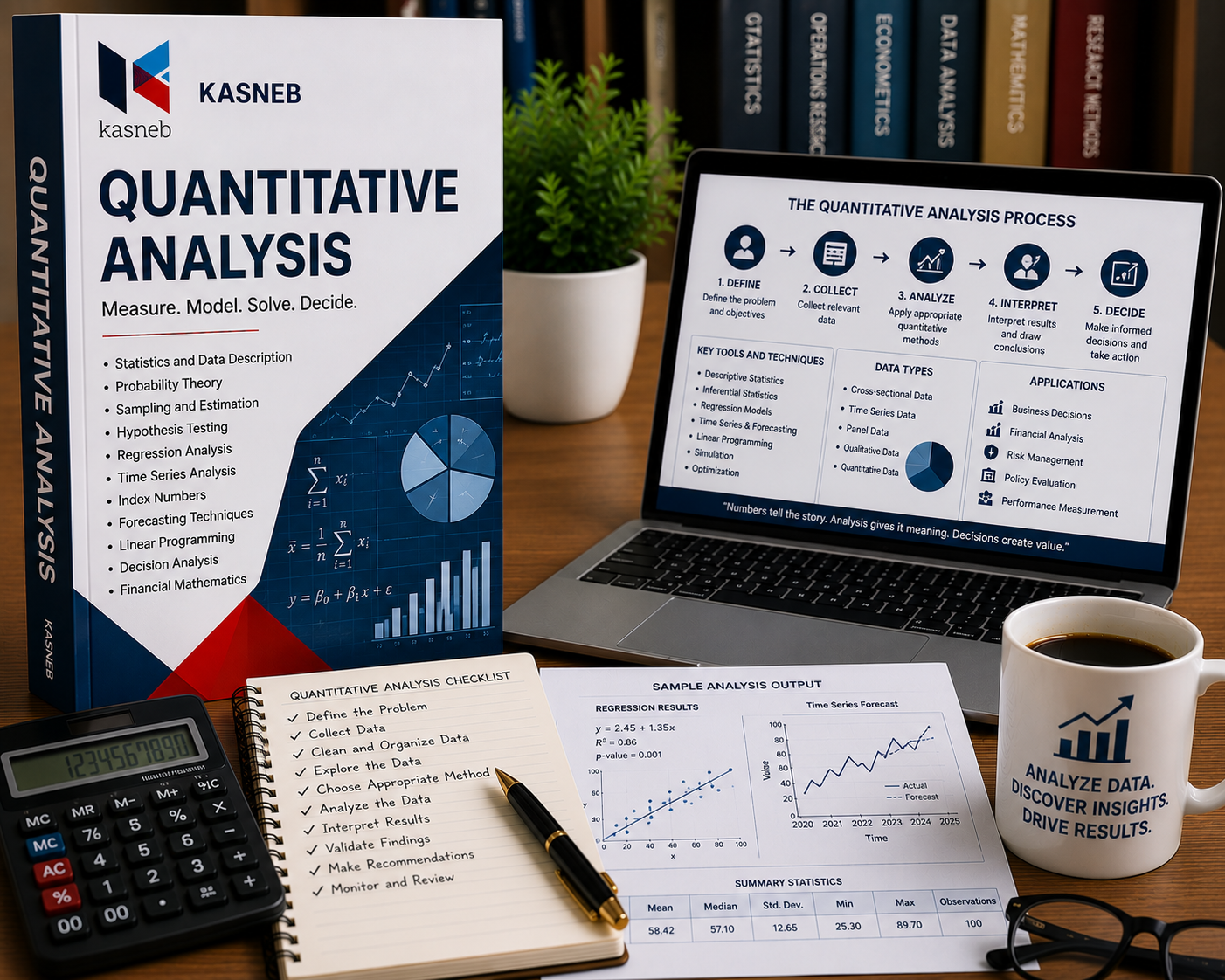
CA15: Quantitative Analysis introduces learners to the use of mathematical and statistical techniques for analyzing data, solving problems, and supporting effective decision-making in business and professional environments. The course develops analytical skills required to interpret numerical information, evaluate alternatives, and make informed decisions based on quantitative evidence.
The course focuses on essential concepts such as data analysis, statistical methods, probability, mathematical modeling, and decision-making techniques. Learners gain the ability to apply quantitative approaches to business challenges, evaluate performance, and understand patterns that support planning and strategy development.
Through practical exercises and real-world applications, the course enhances logical thinking, problem-solving abilities, and confidence in using quantitative information to support business operations and professional decision-making.
CONTEXT:
- Mathematical Techniques
- Functions
- Definition
- Functions, equations, inequalities and graphs; linear, quadratic, cubic, Exponential and logarithmic functions
- Application of mathematical functions in solving business problems
- Matrix Algebra
- Definition
- Types and operations (addition, subtraction, multiplication, transposition and inversion of up to order 3x3)
- Application of matrices; statistical modelling, Markov analysis, input-output analysis and general applications
- Calculus
- Differentiation
- Definition
- Rules of differentiation (general rule, chain, product, quotient)
- Differentiation of exponential and logarithmic functions
- Turning points (maxima, minima and inflexion)
- Application of differentiation to business problems
- Integration
- Definition
- Rules of integration (general rule)
- Integration of exponential and logarithmic functions
- Applications of integration to business problems
- Descriptive Statistics
- Measures of central tendency: mean: arithmetic mean, weighted arithmetic mean; geometric mean, harmonic mean, median and mode
- Measures of dispersion: range, quartile, deciles, percentiles, mean deviation, standard deviation and coefficient of variation
- Measures of skewness: Pearson’s coefficient of skewness, product
- coefficient of skewness
- Measures of kurtosis: Pearson’s coefficient of kurtosis, product coefficient
- of kurtosis
- Probability
- Set Theory
- Definition
- Types of sets
- Set description; enumeration and descriptive properties of sets
- Venn diagrams (order - Venn diagrams precede operation of sets)
- Operations of sets; union, intersection, complement and difference
- Probability Theory and Distribution
- Probability Theory
- Definitions; event, outcome, experiment, sample space, probability space
- Types of events: elementary, compound, dependent, independent, mutually exclusive, exhaustive, mutually inclusive
- Laws of probability; additive and multiplicative laws
- Conditional probability and probability trees
- Expected value, variance, standard deviation and coefficient of variation using frequency and probability
- Application of probability and probability distributions to business problems
- Probability Distributions
- Discrete and continuous probability distributions Z, F, test statistics (geometric, uniform, normal, t distribution, binomial, Poisson and exponential and chi-square)
- Application of probability distributions to business problems
- Hypothesis Testing and Estimation
- The arithmetic mean and standard deviation
- Hypothesis tests on the mean (when population standard deviation is unknown)
- Hypothesis tests on proportions
- Hypothesis tests on the difference between two proportions using Z and t statistics
- Chi-Square tests of goodness of fit and independence
- Hypothesis testing using R statistical software
- Correlation and Regression Analysis
- Correlation Analysis
- Scatter diagrams
- Measures of correlation - product-moment and rank correlation coefficients (Pearson and Spearman) using R software
- Regression Analysis
- Simple and multiple linear regression analysis
- Assumptions of linear regression analysis
- Coefficient of determination, standard error of the estimate, standard error of the slope, t and F statistics
- Time series
- Definition of time series
- Components of time series (circular, seasonal, cyclical, irregular/ random, trend)
- Application of time series
- Methods of fitting trend; freehand, semi-averages, moving averages, least-squares methods
- Models - additive and multiplicative models
- Measurement of seasonal variation using additive and multiplicative models
- Forecasting time series value using moving averages, ordinary least squares method and exponential smoothing
- Linear programming
- Definition of decision variables, objective function and constraints
- Assumptions of linear programming
- Solving linear programming using graphical method
- Solving linear programming using simplex method (basic scenarios)
- Decision Theory
- Definition
- Decision-making process
- Decision-making environment; deterministic situation (certainty)
- Decision making under risk - expected monetary value, expected opportunity loss, risk using the coefficient of variation, the expected value of perfect information
- Decision trees - sequential decision, the expected value of sample information
- Decision making under uncertainty - maximin, maximax, minimax regret, Hurwicz decision rule, Laplace decision rule.
Want to submit a review? Login