CA22: Financial Management

- 16 Sections
- 64 Lessons
Join Live Zoom Class
4 Lessons
Topic 1
5 Lessons
Topic 2
1 Lesson
Topic 3
42 Lessons
- Time Value of Money
- 14TH SEP TOPIC 3:THE VALUE OF MONEY
- 15TH SEP SUBTOPIC: COMPOUNDING, DISCOUNTING
- 16TH SEP SUBTOPIC: DISCOUNTING
- 21ST SEP MON(DAY CLASS) BY MR. NYAMU - TOPIC: BUSINESS AND FINANCIAL ASSETS VALUATION MODELS
- 22ND SEP TUE (DAY CLASS) BY MR. NYAMU - SUBTOPIC: SUPER PROFITS METHOD,PRICE EARNINGS RATIO METHOD
- 23RD SEP WED(DAY CLASS) BY MR. NYAMU - A BRIEF CLASS ON :IRREGULAR GROWTH FIRM,CONTINUES IN THE EVENING CLASS VIDEO
- 23RD SEP WED(EVENING CLASS) BY MR. NYAMU- SUBTOPIC: SUPER PROFIT METHOD,EARNINGS VALUATION METHOD etc
- 25TH SEP FRI (EVENING CLASS) BY MR. NYAMU - TOPIC: BUSINESS AND FINANCIAL MODES OF VALUATION
- 26TH SEP SAT (EARLY MORNING CLASS) BY MR. NYAMU - TOPIC : BUSINESS AND FINANCIAL ASSETS VALUATION MODELS
- 26TH SEP SAT(DAY/EVENING CLASS) BY MR. NYAMU - TOPIC: WALTER'S MODEL,EVA,MURT,VALUATION OF PREFERENCE SHARES
- 27TH SEP SUN(EARLY MORNING CLASS) BY MR. NYAMU - SUBTOPIC: THEORIES OF VALUATION
- 28TH SEP MON (EARLY MORNING CLASS) BY MR. NYAMU - SUBTOPIC: EFFICIENT MARKET HYPOTHESIS
- 28TH SEP MON( DAY CLASS) BY MR. NYAMU - SUBTOPIC: WALTER'S MODEL,ECONOMIC VALUE ADDED, MARKET VALUE ADDED
- 29TH SEP TUE( DAY CLASS) BY MR. NYAMU - TOPIC: VALUATION OF BONDS
- 30TH SEP WED( DAY CLASS) BY MR. NYAMU- SUBTOPIC: YIELD TO MATURITY
- 30TH SEP WED(EVENING CLASS) BY MR. NYAMU - SUBTOPIC: VALUATION OF BONDS
- 3RD OCT SAT( EARLY MORNING CLASS) BY MR. NYAMU - TOPIC: VALUATION OF SECURITIES
- 3RD OCT SAT( EVENING CLASSES) BY MR. NYAMU - TOPIC: VALUATION OF MODELS
- 5TH OCT MON(EARLY MORNING CLASS) BY MR. NYAMU - TOPIC: CAPITAL STRUCTURE DECISIONS
- 5TH OCT MON(DAY CLASS) BY MR. NYAMU - TOPIC: INTRODUCTION TO CAPITAL STRUCTURE DECISIONS
- 6TH OCT TUE(DAY CLASS) BY MR. NYAMU - SUBTOPIC: WEIGHTED AVERAGE COST OF CAPITAL(WACC)
- 7TH OCT WED(DAY CLASS) BY MR. NYAMU - SUBTOPIC: WACC
- 7TH OCT WED(EVENING CLASS) BY MR. NYAMU - TOPIC:CAPITAL STRUCTURE DECISIONS
- 10TH OCT SAT(EVENING CLASS) BY MR. NYAMU - TOPIC:WEIGHTED AVERAGE COST OF CAPITAL
- 11TH OCT SUN(EARLY MORNING CLASS) BY MR. NYAMU - SUBTOPIC: WEIGHTED AVERAGE COST OF CAPITAL
- 12TH OCT MON (EARLY MORNING CLASS) BY MR. NYAMU - SUBTOPIC: POINT OF INDIFFERENCE
- 12TH OCT MON(DAY CLASS) BY MR. NYAMU - SUBTOPIC: BREAK POINTS IN WMCC
- 13TH OCT TUE(DAY CLASS) BY MR. NYAMU - SUBTOPIC:POINT OF INDIFFERENCE,LEVERAGE
- 14TH OCT WED(DAY CLASS) BY MR. NYAMU - TOPIC: CAPITAL BUDGETING
- 14TH OCT WED(EVENING CLASS) BY MR. NYAMU - SUBTOPIC: POINT OF INDIFFERENCE
- 16TH OCT FRI (EVENING CLASS) BY MR. NYAMU - SUBTOPIC: LEVERAGE
- 17TH OCT SAT(EARLY MORNING CLASS) BY MR. NYAMU - SUBTOPIC: LEVERAGE
- 17TH OCT SAT(EVENING CLASS) BY MR. NYAMU - TOPIC: CAPITAL BUDGETING
- 19TH OCT MON(EARLY MORNING CLASS) BY MR. NYAMU - TOPIC:CAPITAL BUDGETING
- 21ST OCT WED(DAY CLASS) BY MR. NYAMU - SUBTOPIC: SPECIAL CASES IN CAPITAL BUDGETING
- 21ST OCT WED(EVENING CLASS) BY MR. NYAMU - SUBTOPIC: SPECIAL CASES IN CAPITAL BUDGETING DECISIONS
- 24TH OCT SAT(EARLY MORNING CLASS) BY MR. NYAMU - SUBTOPIC: SPECIAL CASES IN CAPITAL BUDGETING
- 24TH OCT SAT(EVENING CLASS) BY MR. NYAMU - SUBTOPIC: REPLACEMENT DECISIONS
- 26TH OCT MON(EARLY MORNING CLASS) BY MR. NYAMU - TOPIC: PORTFOLIO THEORY
- 26TH OCT MON(DAY CLASS) BY MR. NYAMU - SUBTOPIC: REPLACEMENT DECISIONS(ILLUSTRATION QUESTIONS)
- 27TH OCT TUE(DAY CLASS) BY MR. NYAMU - TOPIC: PORTFOLIO ANALYSIS
Topic 4
1 Lesson
Topic 5
1 Lesson
Topic 6
1 Lesson
Topic 7
1 Lesson
Topic 8
1 Lesson
Topic 9
1 Lesson
Topic 10
1 Lesson
Topic 11
1 Lesson
Topic 12
1 Lesson
Topic 13
1 Lesson
Topic 14
1 Lesson
Topic 15
1 Lesson
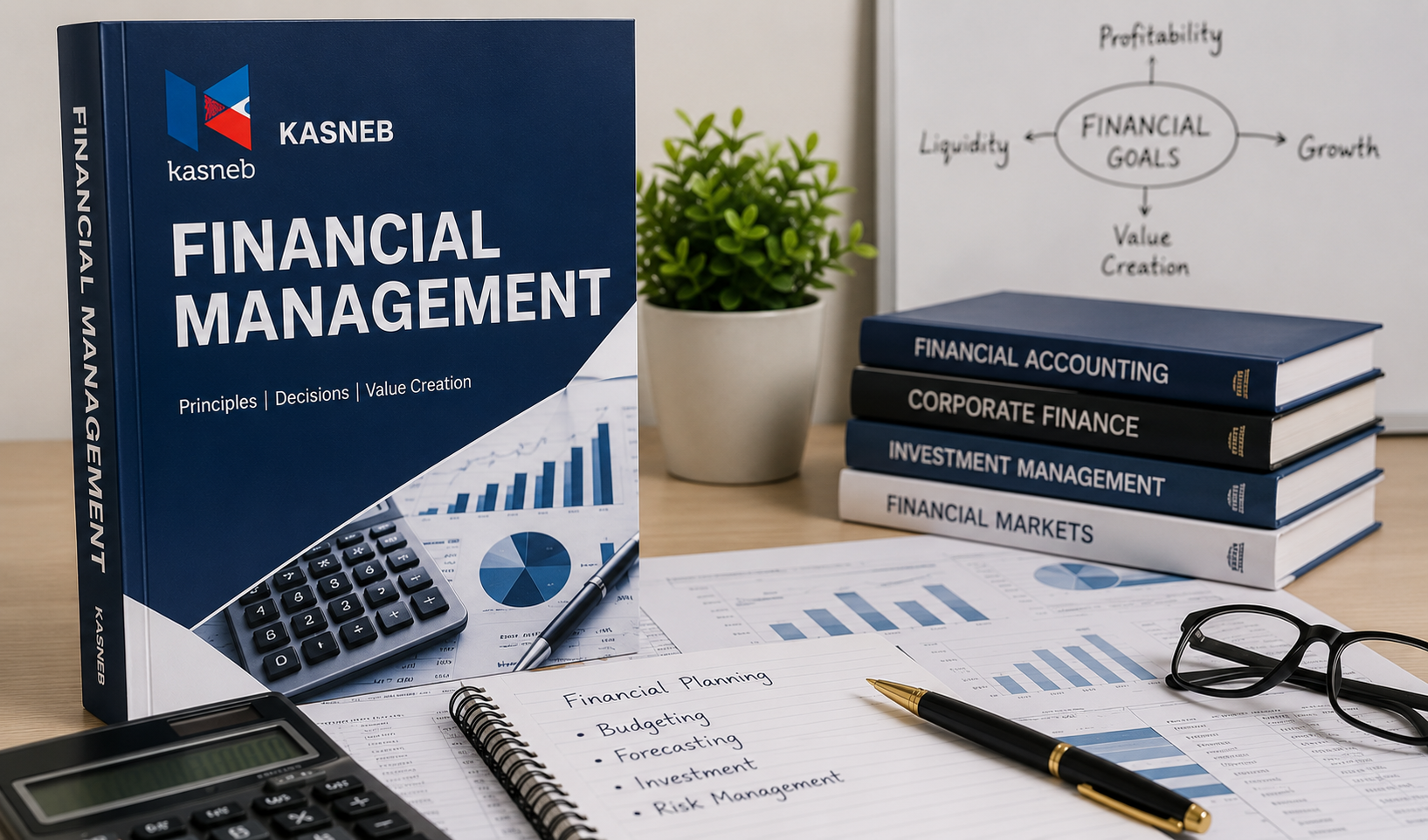
CA22: Financial Management is an Intermediate Level paper in the KASNEB CPA qualification. The course equips students with the knowledge, skills, and techniques required to plan, obtain, allocate, control, and optimize an organization's financial resources to maximize shareholder wealth while managing financial risk.
Key Topics Covered
- Overview of financial management
- Theoretical framework of financial management - The role and responsibilities of a finance manager towards shareholders, employees, society, government and other stakeholders.
- Goals of a firm and corporate strategy; financial and non-financial objectives, overlaps and conflicts among the objectives
- Agency theory, stakeholder’s theory and corporate governance
- Measuring managerial performance, compensation and incentives
- Ethical issues in financial management
- The financing decision
- Nature and objectives of the financing decision
- Factors to consider when making financing decisions
- Sources of finances for enterprises; internally generated funds and the externally generated funds, long term sources (equity, debt, hybrids, lease finance, venture capital, business angel finance, private equity, asset securitisation and sale, Islamic finance and initial coin offerings), medium term sources such as medium term loans and hire purchase financing and short term sources of finance such as overdraft finance, trade credit, issue of commercial papers, accruals, deferred income; characteristics of each source of finance, pros and cons of the various sources of finance.
- Evaluation of financing options
- Methods of issuing ordinary shares - Public issue, private placement, bonus issue, employee stock option plans (ESOPS) and rights issues
- Financial institutions and markets
- Overview of a financial system - Financial markets, financial institutions and financial instruments
- Nature and role of financial markets - primary and secondary securities market, money and the capital markets, over-the counter and organised market, derivatives market, mortgage market, forex market
- Nairobi securities exchange (NSE, or equivalent entity in other jurisdictions) - The role and functions of the securities exchange, securities exchange terminologies, security exchange listing and cross border listing, share indices, timing of investment at the securities exchange, Central depository system and automated trading system, de-mutualisation
- Stock market indices
- Central depository system and automated trading system
- Timing of investment at the securities exchange - Dow theory and Hatch system of timing
- The financial institutions and intermediaries: commercial banks, savings and loans associations and co-operative societies, foreign exchange bureaus, unit trusts and mutual funds, insurance companies and pension firms, insurance agencies and brokerage firms, investment companies, investment banks and stock brokerage firms, micro-finance institutions and small and medium enterprises (SMEs)
- Regulation of financial markets; Central bank of Kenya (CBK, or equivalent entity in other jurisdictions) - The role of the Central bank and the Monetary policy of the central bank; Capital market authority and the Insurance regulatory authority
- Factors responsible for the rapid development of financial institutions and markets
- Risks facing financial institutions
- Time-value of money
- Concept of time value of money
- Relevance of the concept of time value of money in financial management
- Time value of money versus time preference of money
- Time line
- Real versus nominal cash flows
- Compounding techniques - Compound interest, Future value (FV) of a single cash flow and series of cash flows; Compounding of annuity cash flows
- Discounting techniques - Present value (PV) of a future cash flow and series of future cash flows and discounting of annuity cash flows
- Loan amortisation and sinking funds
- Business/Financial asset Valuation models
- Concept of value; book value, going concern value, substitution value, replacement value, conversion value, liquidation value, intrinsic value and market value
- Reasons for valuing financial assets/business
- Theories on valuation of financial assets; fundamental theory, technical theory, random walk theory and the efficient market hypothesis
- Valuation of redeemable, irredeemable and convertible debentures/ corporate bonds
- Valuation of redeemable, irredeemable and convertible preference shares
- Valuation of ordinary shares; net asset basis, price-earnings ratio basis, capitalisation of earnings basis, Gordon’s model, finite earnings growth model, Super-profit model, Walter’s model, discounted free cash flow, residual income model, Use of relative measures such as Economic Value added (EVA) and Market Value Added (MVA)
- Valuation of rights issues
- Valuation of unit trusts and mutual funds
- Valuation of private companies: income and market-based approaches
- Introduction to capital structure decisions
- The meaning of capital structure and the factors to be taken into account when making capital structure decision.
- Cost of capital; Meaning of cost of capital, practical applications of cost of capital, component costs of capital
- The firm’s overall cost of capital; Weighted average cost of capital (WACC), Weighted marginal cost of capital (WMCC) and factors influencing the firm’s Cost of capital.
- Leverage and Risk; Operating leverage and Operating risk, financial leverage and financial risk and total leverage and total risk.
- Analysis of Operating profit (EBIT), Earning per share (EPS) at the point of indifference in the firm’s earnings; Determination of the range of firm’s operating profit (EBIT) within which each financing option will be recommended
- Introduction to capital budgeting decisions
- The nature and importance of capital investment decisions
- Capital budgeting process
- Capital investment’s cash flows - initial cash outlay, terminal cash flows and annual net operating cash flows, incremental approach to cash flow estimation
- Capital investment appraisal techniques
- Non-discounted cash flow methods - payback period and accounting rate of return
- Discounted cash flow methods - net-present value, internal rate of return, profitability index, discounted payback period and modified internal rate of return (MIRR)
- Strengths and weaknesses of the investment appraisal techniques
- Expected relations among an investment’s NPV, company value and share price
- Capital investment options - timing option, strategic investment option, replacement option and abandonment option
- Problems/difficulties encountered when making capital investment decisions in reality
- Financial statements analysis and forecasting
- Scope of financial statement analysis, major financial statements and other information sources, financial statement analysis frame work and users of financial statements and their information needs
- Financial Statement analysis verses Business analysis
- Techniques of financial Statement analysis; Cross-Sectional analysis, Time series analysis and a combination of both techniques.
- Types of financial statement analysis
- Ratio analysis; nature of financial ratios, classification and calculation of financial ratios and limitation of financial ratios
- Common size statements - Vertical and horizontal analysis
- Financial forecasting; cash budgeting and percentage of sales method of forecasting
- Working capital management
- Introduction and concepts of working capital
- Working capital versus working capital management
- Factors influencing working capital requirements of a firm
- Types of working capital
- Importance and objectives of working capital management
- Working capital operating cycle; the importance and computation of the working capital operating cycle
- Working capital financing policies: Aggressive, conservative and matching financing policy
- Determining the finance mix: basic approaches for determining an appropriate Working Capital finance mix; Hedging or matching approach, conservative approach, aggressive approach.
- Management of inventory: kinds of inventory, objectives of Inventory Management, Techniques of Inventory Management; stock levels, Economic Order Quantity (EOQ) and Just-In-Time(JIT).
- Cash Management; Motives of holding cash, techniques of managing cash, cash management models-Baumol model, Miller-Orr model and Orgler’s model
- Management of accounts receivable and accounts payable; assessing creditworthiness, collecting amounts owing, trade credit
- Dividend decision
- Meaning and significance of dividend policy
- Factors influencing dividend policy
- Forms of dividend: script dividend, cash dividend, stock dividend, bond dividend, property dividend
- Dividend theories; Bird in hand theory, Clientele effect theory, Information signalling theory, Walter’s model, Gordon Model, Tax differential theory, Modigliani and Miller dividend irrelevance theory
- Types of dividend policy: regular dividend policy, stable dividend policy, irregular dividend policy, zero dividend policy.
- The impact of dividend payout on share price
- Introduction to portfolio analysis
- Introduction - Risk-return trade off/relationship, Distinction between risk free and risky assets
- Expected return, Standard deviation of returns and the Relative risk of an individual asset
- Expected return of a 2 asset-portfolio
- The Covariance and correlation coefficient of returns of assets.
- The actual portfolio risk of a 2-asset portfolio using the analytical and mathematical model and its interpretation
- Islamic finance
- Justification for Islamic Finance; history of Islamic finance; capitalism; halal; haram; riba; gharar; usury
- Benefits and deficiencies of Islamic Finance
- Principles underlying Islamic finance: principle of not paying or charging interest, principle of not investing in forbidden items; ethical investing; moral purchases
- The concept of interest (riba) and how returns are made by Islamic financial securities
- Sources of finance in Islamic financing
- Types of Islamic financial products:- sharia-compliant products: Islamic investment funds; takaful the Islamic version of insurance Islamic mortgage, murabahah, Leasing - ijara; safekeeping - Wadiah; sukuk - islamic bonds and securitisation; sovereign - sukuk; Islamic investment funds; Joint venture - Musharaka, Islamic banking, Islamic contracts, Islamic treasury products and hedging products, Islamic equity funds; Islamic derivatives
- International standardisation/regulations of Islamic Finance: case for standardisation using religious and prudential guidance, National regulators, Islamic Financial Services Board
- Personal financial management
- Financial Problems encountered in managing individual financial affairs
- Savings and investment considerations
- Personal risk management
- Cost of credit
- Financial Alterations - Retirements; Estate and Tax planning and family budgeting
- Contemporary issues and emerging trends
- Globalisation and growth of derivative markets and securitisation
- Cryptocurrency
- Block chain technology
- Cloud funding
- Digitisation of financial transactions
- Behavioural finance
- Big data project finance
- Sample reading and reference material
- Pandey, I.M. (2016). Financial Management, 11th Edition
- Damodaran, S.A. (2015). Corporate finance theory and practice.
- McLaney, E. Business finance theory and practice - 7th Edition
- Myers, R.B. (2017). Principles of corporate finance
- Kasneb e-learning resources (link on kasneb website)
- Kasneb approved study packs
Want to submit a review? Login