CA25: Management Accounting

- 16 Sections
- 58 Lessons
Join Live Zoom Class
1 Lesson
Topic 1
3 Lessons
Topic 2
41 Lessons
- Cost Concepts and Classification
- 9TH SEP TOPIC: COST CLASSIFICATION
- 14TH SEP COST COMOTION
- 16TH SEP SUBTOPIC: REGRESSION ANALYSIS
- 22ND SEP TUE(DAY CLASS) BY MR. GITHINJI - EOQ MULTIPLE DISCOUNTS
- 23RD SEP WED( EARLY MORNING CLASS) BY MR. GITHINJI- TOPIC: MATERIAL COSTS
- 26TH SEP SAT(DAY CLASS) BY MR. GITHINJI - SUBTOPIC: EOQ AND DISCOUNTS
- 28TH SEP MON(EARLY MORNING CLASS) BY MR. GITHINJI - SUBTOPIC: EOQ WITH DISCOUNTS
- 28TH SEP MON ( DAY CLASS) BY MR. GITHINJI - SUBTOPIC: WEIGHTED AVERAGE,MATERIAL COST ALLOCATION
- 28TH SEP MON(EVENING CLASS) BY MR, GITHINJI - SUBTOPIC: STOCK VALUATION
- 29TH SEP TUE(DAY CLASS) BY MR. GITHINJI - TOPIC: LABOUR COSTING
- 30TH SEP WED(EARLY MORNING CLASS) BY MR. GITHINJI - TOPIC: EOQ
- 30TH SEP WED( DAY CLASS) BY MR. GITHINJI - TOPIC : TREATMENT OF PAY FOR HOURS OF INDIRECT WORK
- 3RD OCT SAT( EVENING CLASS) BY MR. GITHINJI - TOPIC: MATERIAL COSTING
- 4TH OCT SUN(EARLY MORNING CLASS) BY MR. GITHINJI - TOPIC: MATERIAL COSTING ,LABOUR COSTING PRT 1
- 4TH OCT SUN(EARLY MORNING CLASS) BY MR. GITHINJI - TOPIC: MATERIAL COSTING ,LABOUR COSTING PRT 2
- 4TH OCT SUN(EARLY MORNING CLASS) BY MR. GITHINJI - TOPIC: MATERIAL COSTING ,LABOUR COSTING PRT 3
- 5TH OCT MON(EARLY MORNING CLASS) BY MR. GITHINJI -SUBTOPIC: METHODS OF REMUNERATION
- 5TH OCT MON( DAY CLASS) BY MR. GITHINJI - SUBTOPIC: ALLOCATION OF WAGES
- 5TH OCT MON(EVENING CLASS) BY MR. GITHINJI - TOPIC: LABOUR COSTING( METHODS OF REMUNERATION)
- 7TH OCT WED( EARLY MORNING CLASS) BY MR. GITHINJI - SUBTOPIC: REJECTED OUTPUT
- 7TH OCT WED( DAY CLASS) BY MR. GITHINJI - SUBTOPIC: OVEREADS DISTRIBUTION
- 10TH OCT SAT(EVENING CLASS) BY MR. GITHINJI- SUBTOPIC:ALLOCATION OF WAGES
- 12TH OCT MON(EARLY MORNING CLASS) BY MR. GITHINJI- SUBTOPIC: WAGES ALLOCATION(CONTINUATION)
- 12TH OCT MON(ADAY CLASS) BY MR. GITHINJI - SUBTOPIC: RE-APPORTIONMENT OF SERVICE DEPARTMENT OVERHEADS
- 12TH OCT MON(EVENING CLASS) BY MR. GITHINJI - SUBTOPIC: ALLOCATION OF WAGES (CONTINUATION)
- 13TH OCT TUE(DAY CLASS) BY MR. GITHINJI - SUBTOPIC: OVERHEAD ABSORPTION
- 14TH OCT WED(EARLY MORNING CLASS) BY MR. GITHINJI - SUBTOPIC: ALLOCATION APPORTIONMENT
- 14TH OCT WED(DAY CLASS) BY MR. GITHINJI - SUBTOPIC: OVERHEAD ABSORPTION(CONTINUATION)
- 17TH OCT SAT(EVENING CLASS) BY MR. GITHINJI - SUBTOPIC: ALLOCATION AND APPORTIONMENT
- 18TH OCT SUN(EARLY MORNING CLASS) BY MR. GITHINJI - SUBTOPIC: REAPPORTIONMENT OF SERVICE DEBT OVERHEADS
- 19TH OCT MON(EARLY MORNING CLASS) BY MR. GITHINJI - SUBTOPIC: PRODUCT COSTING
- 19TH OCT MON(DAY CLASS) BY MR. GITHINJI - SUBTOPIC: OVER/ UNDER ABSORPTION
- 21ST OCT TUE(EARLY MORNING CLASS) BY MR. GITHINJI - SUBTOPIC: OVER/UNDER ABSORPTION
- 21ST OCT WED(DAY CLASS) BY MR. GITHINJI - SUBTOPIC: ABC COSTING
- 24TH OCT SAT(EVENING CLASS) BY MR. GITHINJI - REAPPORTIONMENT AND ABSORPTION
- 26TH OCT MON(EARLY MORNING CLASS) BY MR. GITHINJI - SUBTOPIC: ABC COSTING
- 26TH OCT MON(DAY CLASS) BY MR. GITHINJI - TOPIC: COSTING METHODS
- 26TH OCT MON(DAY CLASS) BY MR. GITHINJI - TOPIC: PROCESS COSTING( PROCESS LOSSES)
- 26TH OCT MON(EVENING CLASS) BY MR. GITHINJI - SUBTOPIC: OVERHEAD ABSORPTION
- 27TH OCT TUE(DAY CLASS) BY MR. GITHINJI - TOPIC: PROCESS COSTING
Topic 3
1 Lesson
Topic 4
1 Lesson
Topic 5
1 Lesson
Topic 6
1 Lesson
Topic 7
1 Lesson
Topic 8
1 Lesson
Topic 9
1 Lesson
Topic 10
1 Lesson
Topic 11
1 Lesson
Topic 12
1 Lesson
Topic 13
1 Lesson
Topic 14
1 Lesson
Topic 15
1 Lesson
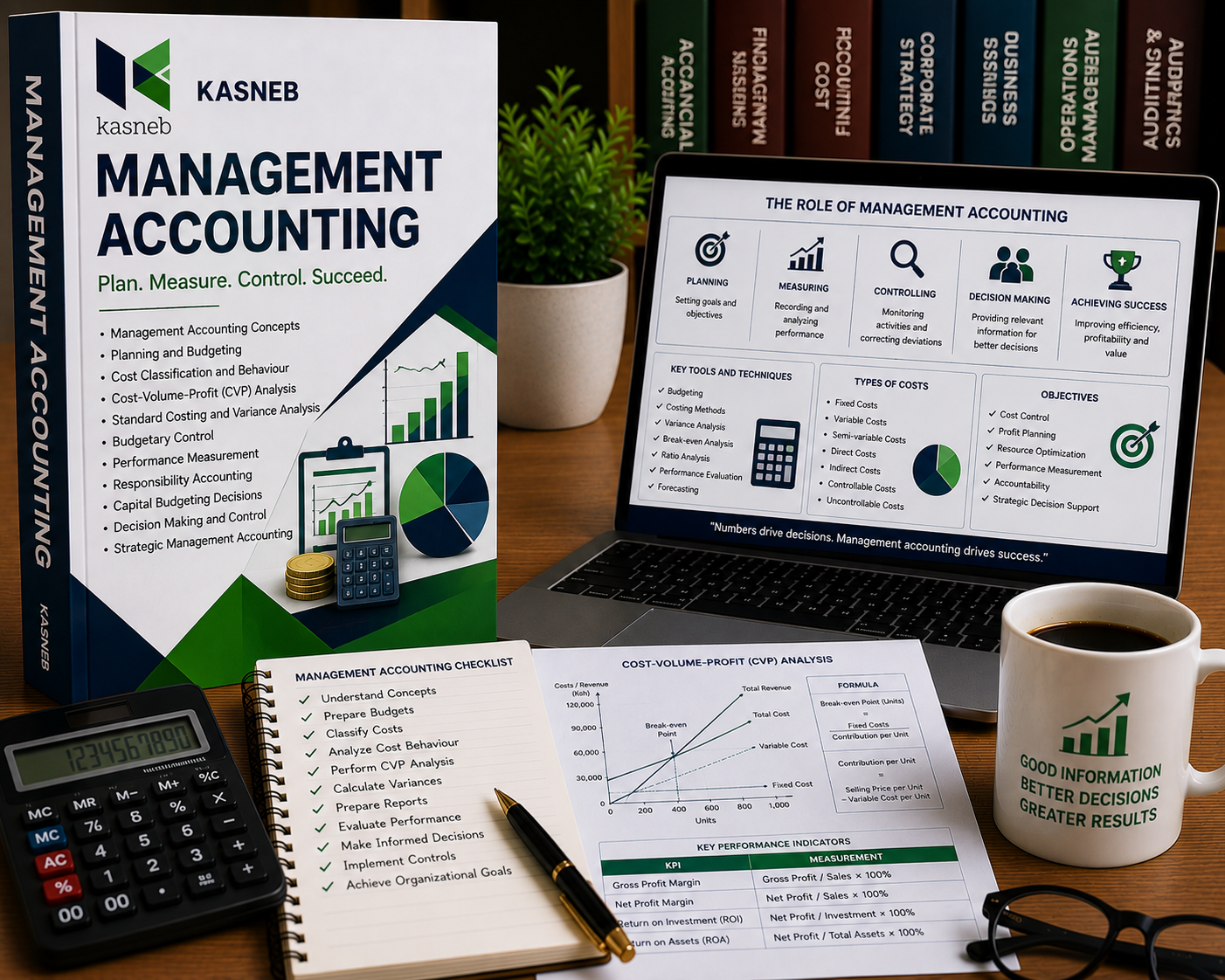
CA25: Management Accounting is an Intermediate Level paper in the KASNEB CPA qualification. It equips learners with the knowledge and practical skills required to collect, analyze, and interpret financial and non-financial information for planning, decision-making, performance evaluation, and cost control. The course emphasizes the application of management accounting techniques to improve organizational efficiency, profitability, and strategic decision-making.
Key Topics Covered
- The context of management accounting:
- Definition and scope of Cost and Management accounting
- Role of Management Accounting in decision making
- Users of Management accounting information
- Cost accounting as a subset of management accounting
- Management accounting and financial accounting
- Difference between management accounting and financial accounting
- Relationship between Management accountant and other managers
- Limitations of management accounting
- Costing terms and concepts
- Cost definition and identification
- Cost classification
- Cost classification bases; by time; by behaviour; by function; identification with stock; by relevance for decision making; by management control
- Types of cost systems
- Maintaining a cost database
- Introduction to cost estimation
- Non-mathematical methods
- Accounts Analysis method
- High-Low method
- Industrial Engineering method
- Mathematical methods
- Scatter graph method
- Ordinary Least Square method (simple regression only)
- Cost accumulation
- Accounting for direct material cost
- Introduction to Material costing
- Objectives of material control
- Essential requirements of material control system
- Centralised and decentralized purchasing
- Periodic inventory system
- Perpetual inventory system
- Setting stock levels
- Factors influencing stock levels
- Relevant cost for inventory management
- The Economic Order Quantity
- Valuing inventory issues using FIFO, LIFO, standard cost method, weighted average, simple average and replacement cost method
- Accounting for direct labour cost
- Methods of labour remuneration
- Bonus schemes
- Factors influencing wages
- Accounting for overhead cost
- Overhead apportionment
- Primary overhead distribution
- Secondary overhead distribution methods (continuous allocation method, algebraic method, direct allocation method, sequential allocation method)
- Absorption of overheads
- Activity based costing
- Meaning of activity-based costing
- Distinction between activity-based costing and the Traditional absorption costing
- Classification of cost drivers
- The hierarchy of cost drivers
- Overhead absorption rates - ABC
- Income statements - one unit
- Income statement - total output/sales
- Product costing methods
- Introduction to costing methods
- Specific order costing; Job order costing; Batch costing
- Continuous operation costing; Process costing (normal process losses; abnormal process losses/gains); treatment of closing work in progress; treatment of opening work in progress (FIFO and Weighted Average cost methods); Process costing for joint products and by-products; distinction between joint-products and by-products
- Service costing
- Marginal and absorption costing
- Differences between marginal costing and absorption costing
- comparative income statements
- Arguments for the use of marginal costing
- Arguments for the use of absorption costing
- Reconciliation statement
- Cost-volume profit analysis (break-even analysis)
- Introduction to C-V-P analysis
- Assumptions of C-V-P analysis
- Break-even chart
- Profit-volume chart
- Single product C-V-P analysis
- Multiple product C-V-P analysis
- Limitations of C-V-P Analysis
- Applications of marginal costing in decision making (make/buy decisions; discontinue a product; choice of a product where limiting factor exists; acceptance of a special offer); overriding considerations to the above decisions
- Budgetary control
- Introduction to budgets
- Essential features of a budget
- Objectives of budgetary control
- Difference between forecasts and budgets
- Types of budgets
- Classification based on time (long-term budgets, short-term budgets and current budgets)
- Classification based on functions (functional/subsidiary budgets, master budgets)
- Classification based on capacity (fixed budgets, flexible budgets)
- Preparation of budgets
- Functional budgets including cash budget and master budget
- Fixed and flexible budgets
- Standard costing and variance analysis
- Introduction
- Types of standards (basic standards, ideal standards, attainable standards)
- Advantages and disadvantages of standard costing
- Variance analysis
- Material cost variances (usage variance, price variance)
- Labour cost variances (efficiency variance, rate variance)
- Variable overhead variances (expenditure variance, efficiency variance)
- Fixed overhead variances (expenditure variance, capacity variance, efficiency variance and volume variance)
- Sales variances
- Causes of the various variances and remedies
Want to submit a review? Login