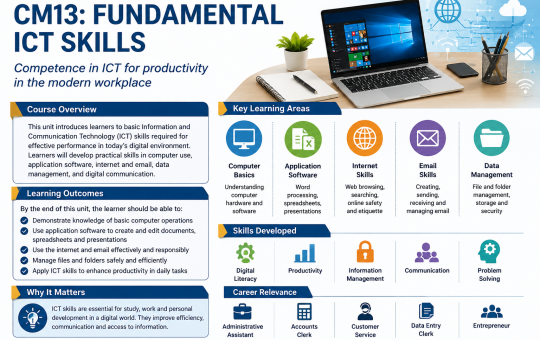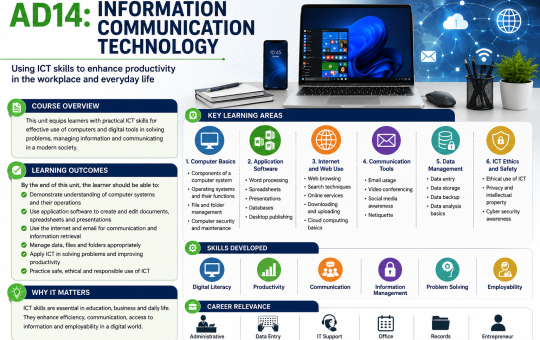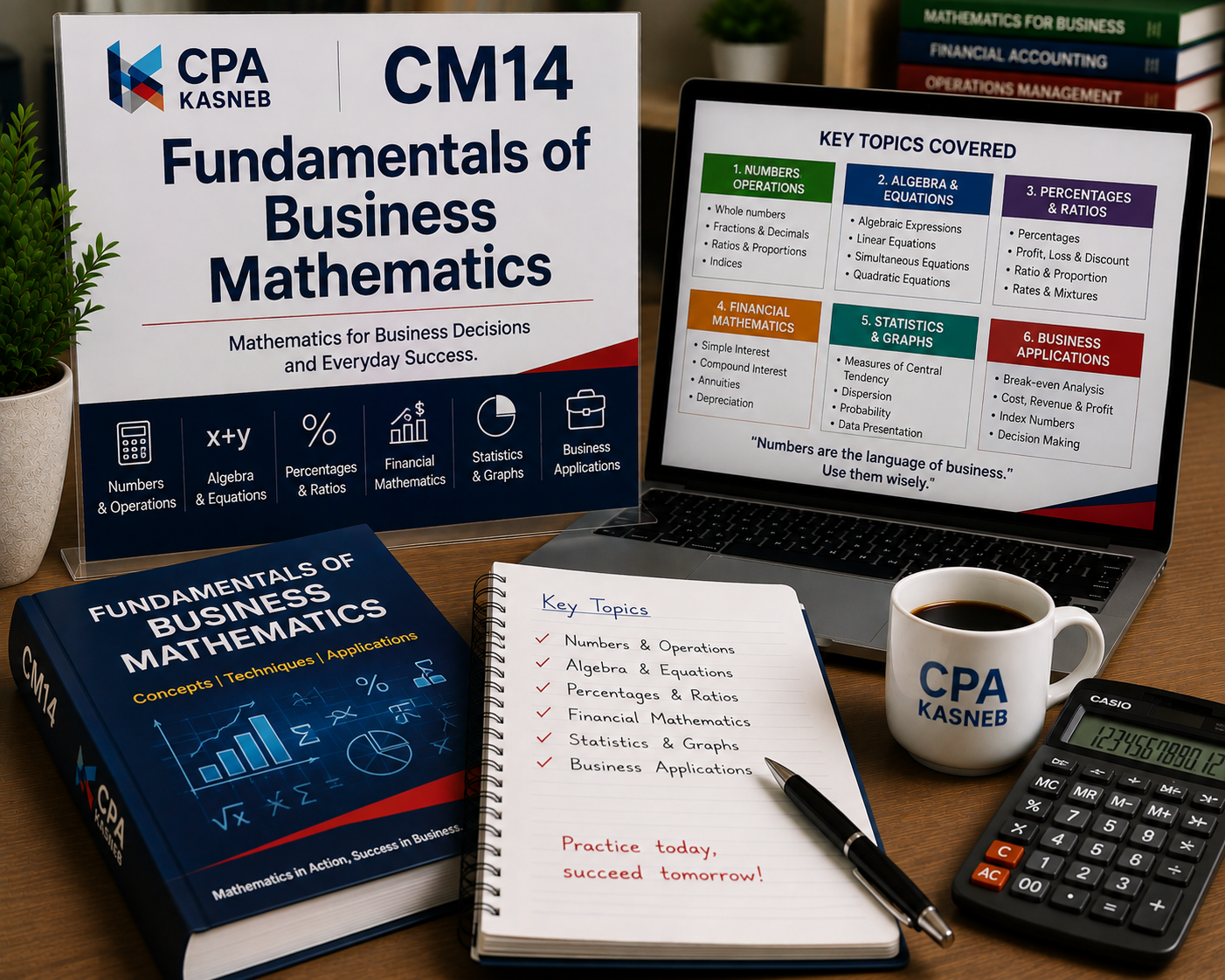
CM14: Fundamentals of Business Mathematics

- 6 Sections
- 21 Lessons
Join Live Zoom Class
1 Lesson
Topic 1
16 Lessons
- Ratios, Rates and Proportions
- 5TH SEP SAT(EVENING CLASS) BY MADAM CAROL - TOPIC: RATIOS, RATES, PROPORTIONS AND PERCENTAGES
- 7TH SEP MON(EVENING CLASS) BY MADAM CAROL - SUBTOPIC: RATIOS,PROPORTION
- 12TH SEP SAT(EVENING CLASS) BY MADAM CAROL - SUBTOPIC: PROPORTIONS,PERCENTAGES
- 14TH SEP MON(EVENING CLASS) BY MADAM CAROL - TOPIC 2: COMMERCIAL MATHEMATICS
- 19TH SEP SAT(EVENING CLASS) BY MADAM CAROL - SUBTOPIC: COMMISSION
- 21ST SEP MON(EVENING CLASS) BY MADAM CAROL - SALARIES AND PAYE
- 26TH SEP SAT(EVENING CLASS) BY MADAM CAROL - SIMPLE AND COMPOUND INTEREST
- 28TH SEP MON(EVENING CLASS) BY MADAM CAROL - SUBTOPIC: FOREIGN EXCHANGE
- 3RD OCT SAT(EVENING CLASS) BY MADAM CAROL - TOPIC: COMMERCIAL MATHEMATICS(APPRECIATION AND DEPRECIATION)
- 5TH OCT MON(EVENING CLASS) BY MADAM CAROL - TOPIC 3: STATISTICS
- 10TH OCT SAT(EVENING CLASS) BY MADAM CAROL - SUBTOPIC: MEAN AND MEDIAN
- 12TH OCT MON(EVENING CLASS) BY MADAM CAROL - SUBTOPIC: MODE
- 17TH OCT SAT(EVENING CLASS) BY MADAM CAROL - SUBTOPIC: STANDARD DEVIATION
- 24TH OCT SAT(EVENING CLASS) BY MADAM CAROL - TOPIC 4: CALCULUS
- 26TH OCT MON(EVENING CLASS) BY MADAM CAROL - TOPIC 5: MATRIX
Topic 2
1 Lesson
Topic 3
1 Lesson
Topic 4
1 Lesson
Topic 5
1 Lesson
CM14: Fundamentals of Business Mathematics is a foundational course that equips learners with the essential mathematical knowledge and quantitative skills required to solve business, financial, and commercial problems. The course emphasizes the application of mathematical techniques in accounting, finance, economics, and management, enabling learners to make accurate calculations, analyze numerical information, and support effective business decision-making.
CONTENT:
- Apply ratios, rates and proportions for comparison of numerical values
- Definition
- Ratios
- Rates
- Proportion
- Differentiate between ratio and proportion
- Solve problems involving rates and proportions
- Conversion between fractions, decimals and percentages
- A decimal to a fraction
- A fraction to a decimal
- A percentage to a fraction or decimal
- A fraction or decimal to a percentage
- Rounding off numbers
- Solve business using fractions, decimals and percentages
- Describe relationships using algebraic expressions and calculus
- Algebraic expression
- The number line
- Known and unknowns (variables)
- Algebraic terms and expressions operation
- Factorisation
- Simplification of algebraic expressions using BODMAS
- Simplification of fractions
- Linear Equations and Inequalities
- Solving equations with one or more variables
- Solving multi-operational equations
- Graphical solutions in two unknowns
- Graphical solutions for inequalities in one unknown
- Graphical presentation of inequalities in two unknowns
- Matrix Algebra
- Notations
- Operations
- Solving a 2*2 matrix
- Calculus
- Basic differentiation (general polynomial rule)
- Stationary points/turning points (minima and maxima)
- Basic integration (general polynomial rule)
- Solve problems using first order differential calculus method and general integration rule
- Apply the concepts of commercial mathematics to compute costs and revenues
- Buying and selling
- Types of discounts
- Percentage profit and loss
- Mark-ups
- Margins
- Simple interest and compound interest computation
- Basics of simple interest
- Compound interest formulae
- Finding principal, rate and time using simple interest formula and compound interest rate formula
- Preparation of a loan mortisation schedule
- Appreciation and depreciation calculation
- Straight line method
- Declining balance method
- Sum of the year’s digits method
- Correctly apply values and variables to any given formula
- Wages and salaries computation
- Piecework
- Hourly rate
- Commissions
- Basic income tax calculations
- Gross and net pay
- Computation of personal income tax
- Foreign exchange rates computation
- Use statistical concepts to analyse and present data
- Data collection
- Definition
- Steps to data collection
- Data collection methods
- Measures of central tendency
- Mean
- Mode
- Median
- Measures of dispersion
- Variance
- Standard deviation
- Presenting data using the following methods
- Tables
- Charts and diagrams
- Frequency distribution table
- Contingency tables
- Stem and leaf plot of data line graphs
- Bar charts
- Pie charts
- Pictograms
- Frequency curve – ogive, histogram and polygons
- Apply probability to exercises anticipate potential business outcomes assess
- Foundation concepts of probability
- Sample space
- Event
- Experiment
- Outcome
- Types of events
- Simple events
- Compound events
- Independent
- Dependent events
- Mutually exclusive events
- Mutually inclusive
- Explain rules/laws of probability
- Draw probability trees
- Solving business problems using probability
5 Star
0%
4 Star
0%
3 Star
100%
2 Star
0%
1 Star
0%
Want to submit a review? Login
Reviews
-
 Oct 5, 2026 @ 3:12 pm
The changes are too frequent