AD23: Business Mathematics and Statistics

- 9 Sections
- 40 Lessons
Join Live Zoom Class
1 Lesson
Topic 1
4 Lessons
Topic 2- PRESENTATION OF DATA
5 Lessons
Topic 3
1 Lesson
Topic 4
1 Lesson
Topic 5
25 Lessons
- Descriptive Statistics
- 17TH SEP TOPIC : DESCRIPTIVE STATISTICS
- 18TH SEP SUCTOPIC: MODE, GEOMETRIC MEAN, HARMONIC MEAN
- 22ND SEP TUE (DAY CLASS) BY MR. KIVUVA - MEASURES OF DISPERSION
- 22ND SEP TUE (EVENING CLASS) BY MR. KIVUVA -SUBTOPIC: GRAPHS
- 24TH SEP THUR(DAY CLASS) BY MR. KIVUVA - SUBTOPIC: MEASURES OF PARTITION
- 25TH SEP FRI ( DAY CLASS) BY MR. KIVUVA - REVISION QUESTIONS ON RESAVIPTIVE STATISTICS
- 26TH SEP SAT(EVENING DAY CLASS) BY MR. KIVUVA - TOPIC: RESCRIPTIVE STATISTICS
- 29TH SEP TUE(DAY CLASS) BY MR. KIVUVA - TOPIC: INDEX NUMBERS(SIMPLE UNWEIGHTED,WEIGHTED INDEX NUMBER
- 29TH SEP TUE (EVENING CLASS) BY MR. KIVUVA - SUBTOPIC : MEASURES OF CENTRAL TENDENCY,MEASURES OF DISPERSION
- 1ST OCT THUR(DAY CLASS) BY MR. KIVUVA - TOPIC 4: INDEX NUMBERS
- 3RD OCT SAT(EVENING CLASS) BY MR. KIVUVA - TOPIC: RESCRIPTIVE STATISTICS
- 6TH OCT TUE(DAY CLASS) BY MR. KIVUVA - TOPIC: SET THEORY
- 6TH OCT TUE (EVENING CLASS) BY MR. KIVUVA - SUBTOPIC: MEASURES OF PARTITION
- 8TH OCT THUR (DAY CLASS) BY MR. KIVUVA - SUBTOPIC: SET OPERATIONS,REVIEW QUESTIONS ON SET THEORY
- 9TH OCT FRI(DAY CLASS) BY MR. KIVUVA - REVIEW QUESTIONS ON SET THEORY
- 10TH OCT SAT(EVENING CLASS) BY MR. KIVUVA - REVIEW QUESTIONS ON DESCRIPTIVE STATISTICS
- 13TH OCT TUE( DAY CLASS) BY MR. KIVUVA - TOPIC 6: LINEAR FUNCTIONS,QUADRATIC FUNCTIONS
- 13TH OCT TUE( EVENING CLASS) BY MR. KIVUVA - TOPIC:INDEX NUMBERS
- 15TH OCT THUR(DAY CLASS) BY MR. KIVUVA -REVIEW QUESTIONS ON FUNCTIONS
- 16TH OCT FRI(DAY CLASS) BY MR, KIVUVA - TOPIC 7 : CALCULUS(DIFFERENTIATION)
- 17TH OCT SAT(EVENING CLASS) BY MR. KIVUVA - SUBTOPIC: QUANTITY INDEX NUMBER
- 22ND OCT THUR(DAY CLASS) BY MR. KIVUVA - APPLICATION OF DIFFERENTIATION
- 23RD OCT FRI(DAY CLASS) BY MR. KIVUVA -SUBTOPIC: INTEGRATION
- 27TH OCT TUE(DAY CLASS) BY MR. KIVUVA - REVIEW QUESTIONS ON CALCULUS
Topic 6
1 Lesson
Topic 7
1 Lesson
Topic 8
1 Lesson
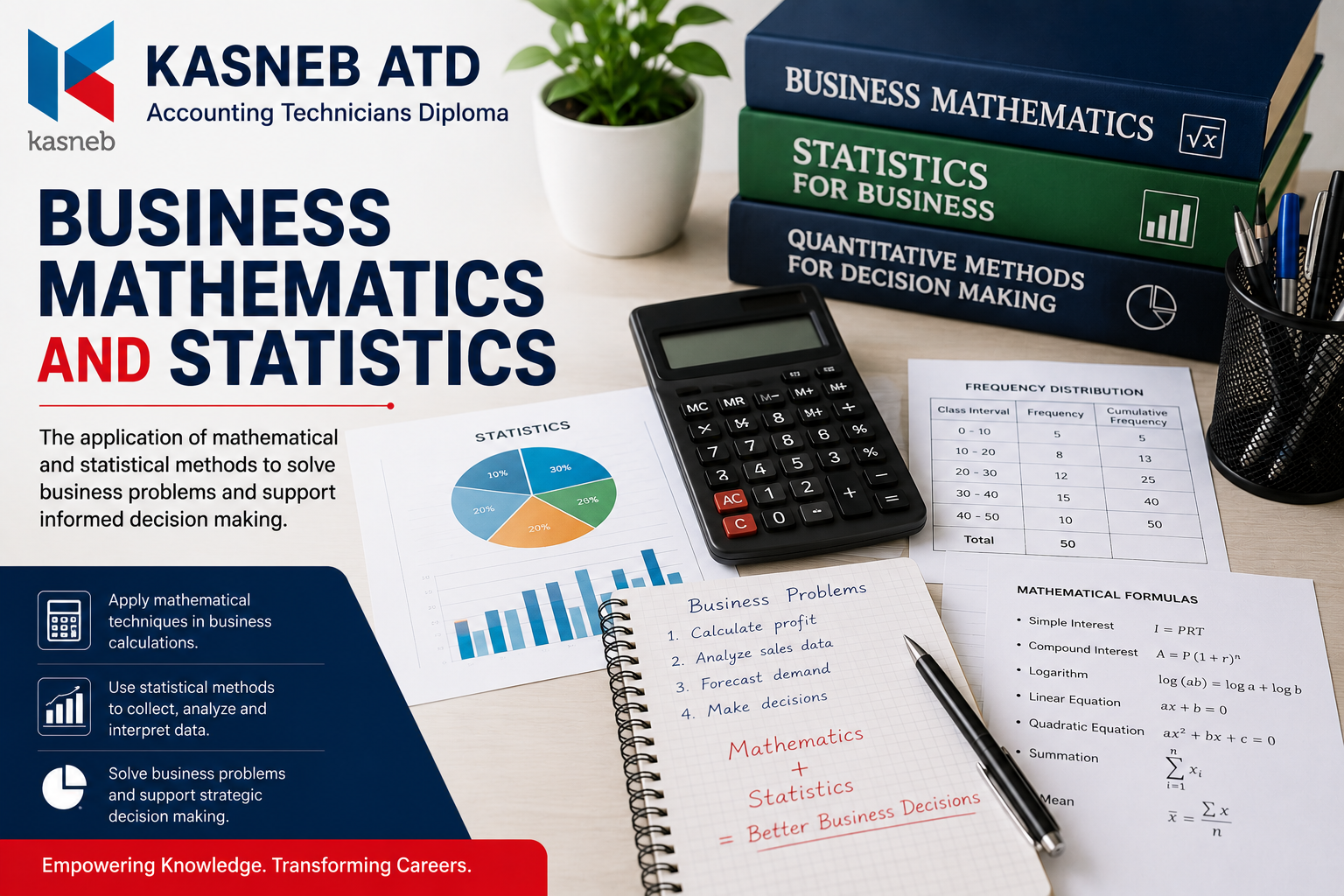
AD23: Business Mathematics and Statistics is a Foundation Level paper in the KASNEB Accounting Technician Diploma (ATD) qualification. It equips learners with the mathematical and statistical knowledge and practical skills required to solve business and financial problems, analyze data, and support informed decision-making. The course emphasizes quantitative techniques used in accounting, finance, economics, and business management.
Key Topics Covered
- Equations
- Linear equations; solving and graphs
- Simultaneous equations; solving
- Quadratic equations; solving and graphs
- Basic calculus; simple differentiation and integration
- Total revenue, total cost and profit equations
- Break-even analysis
- Application of errors; absolute/relative
- Sequences and series
- Arithmetic progression(A.P): nth term, sum of first n terms
- Geometric progression (G.P): nth term, sum of first n terms
- Matrices
- Introduction: order of matrices, types of matrices
- Addition, subtraction and multiplication of matrices
- Determinants of 2x2 matrices
- Inverses of 2x2 matrices
- Application of matrices in solving business problems
- Commercial mathematics
- Buying and selling; discounts, profit and loss, margins and mark-ups
Wages and salaries; piece and hourly rates, commissions, gross and net pay
- Statutory deductions; PAYE, NHIF, NSSF
- Simple and compound interest
- Depreciation and appreciation of assets
- Hire purchase
- Foreign exchange rate transactions
- Introduction to statistics
- Introduction: definitions and branches of statistics
- Methods of data collection: primary and secondary data,
- Sampling techniques
- Presentation of statistical data
- Tables
- Diagrams: bar charts and pie charts
- Graphs: time series graphs, Z-charts, Lorenz curves and semi-logarithmic graphs
- Frequency distribution tables
- Histogram and frequency polygons
- Cumulative frequency curve (ogive) and its application
- Descriptive statistics
- Measures of central tendency: mean: arithmetic mean, weighted arithmetic mean; geometric mean, harmonic mean, median and mode.
- Measures of dispersion: range, quartile, deciles, percentiles, mean deviation, standard deviation and coefficient of variation
- Measures of skewness: pearsons coefficient of skewness, product coefficient of skewness
- Measures of kurtosis: pearsons coefficient of kurtosis, product coefficient of kurtosis.
- Set theory
- Introduction to set theory
- Types of sets: universal, empty/null, subsets, finite and infinite
- Operation of sets: unions, intersections, complements and set difference
- Venn diagrams
- Basic probability theory
- Introduction to probability: definitions, events, outcomes, sample space
- Types of events: simple, compound, independent, mutually exclusive, mutually inclusive, dependent events
- Rules of probability: additive and multiplicative rules
- Introduction to counting techniques, combinations and permutations
- Baye’s Theorem
- Elementary probability trees
- Index numbers
- Construction of index numbers
- Purpose of index numbers
- Simple index numbers; fixed base method and chain base method
- Weighted index numbers; Laspeyre’s, Paasche’s, Fisher’s ideal and Marshall- Edgeworth’s methods (both price and quantity index numbers)
- Consumer Price Index (CPI)
- Applications of CPI
- Limitations of index numbers
- Emerging issues and trends
Want to submit a review? Login