AD31: Principles of Economics


- 11 Sections
- 60 Lessons
Join Live Zoom Class
1 Lesson
Topic 1
6 Lessons
Topic 2
44 Lessons
- Demand, Supply and Price Determination
- 9TH SEP (DAY CLASS) BY MADAM CAROL - TOPIC 2: DEMAND AND SUPPLY AND DETERMINATION OF EQUILIBRIUM
- 11TH SEP (DAY CLASS) BY MADAM CAROL - SUBTOPIC: REGRESSIVE DEMAND
- 11TH SEP (EVENING CLASS) BY MR. WERE - SUBTOPIC: ECONOMIC SYSTEM
- 14TH SEP ( DAY CLASS) BY MADAM CAROL - SUBTOPIC: ARC, ELASTICITY OF DEMAND
- 16TH SEP (DAY CLASS) BY MADAM CAROL - FACTORS INFLUENCING SUPPLY, INDIVIDUAL AND MARKET SUPPLY MOVEMENT AND SHIFT IN SUPPLY CURVE,EXCEPTION TO THE LAW OF SUPPLY
- 18TH SEP (DAY CLASS) BY MADAM CAROL - SUBTOPIC: FACTORS AFFECTING ELASTICITY OF SUPPLY
- 18TH SEP (EVENING CLASS) BY MR. WERE - TOPIC 2: DEMAND ANALYSIS
- 19TH SEP ( EVENING CLASS) BY MR. WERE - TOPIC 2 : EQUILIBRIUM ANALYSIS
- 21ST SEP MON(DAY CLASS) BY MADAM CAROL - SUBTOPIC : PRICE MECHANISM,PRICE CONTROL
- 23TH SEP WED(DAY CLASS) BY MADAM CAROL - SUBTOPICS: COBWEB THEOREM,STABILIZING PROCESS IN THE AGRICULTURAL SECTOR
- 25TH SEP FRI ( EARLY MORNING) BY MR. WERE - EQUILIBRIUM
- 25TH SEP FRI( DAY CLASS) BY MADAM CAROL - SUBTOPIC : INDIFFERENCE CURVE
- 25TH SEP FRI(EVENING CLASS) BY MR. WERE - SUBTOPIC: ELASTICITY
- 26TH SEP SAT(DAY) BY MR. WERE - SUBTOPIC: ELASTICITY
- ELASTICITY ANALYSIS NOTES
- 2ND OCT FRI(EARLY MORNING CLASS) BY MR. WERE - TOPIC: CONSUMER BEHAVIOR
- 2ND OCT THUT(DAY CLASS) BY MADAM CAROL - TOPIC: THEORY OF PRODUCTION
- 2ND OCT FRI(EVENING CLASS) BY MR. WERE - TOPIC: CONSUMER BEHAVIOR PRT 1
- 2ND OCT FRI(EVENING CLASS) BY MR. WERE - TOPIC: CONSUMER BEHAVIOR PRT 2
- 3RD OCT SAT(EARLY MORNING CLASS) BY MR. WERE - TOPIC: PRODUCTION
- 7TH OCT WED( EARLY MORNING CLASS) BY MR. WERE - TOPIC: CONSUMER BEHAVIOR(ORDINAL APPROACH
- 7TH OCT WED(DAY CLASS) BY MADAM CAROL- SUBTOPIC: ISOQUANT
- 9TH OCT FRI( EARLY MORNING) BY MR. WERE - TOPIC: PRODUCTIONS THEORY
- 9TH OCT FRI(DAY CLASS) BY MADAM CAROL - SUBTOPIC: THEORY OF COST
- 9TH OCT SAT(EVENING CLASS) BY MR. WERE - SUBTOPIC: PRODUCTION(CONTINUATION)
- 10TH OCT SAT(EVENING CLASS) BY MR. WERE - SUBTOPIC: LEAST FACTOR COMBINATION
- 12TH OCT MON(DAY CLASS) BY MADAM CAROL - SUBTOPIC: LAW OF DIMINISHING RETURNS,TOPIC 5: MARKET STRUCTURES PRT 1
- 12TH OCT MON(DAY CLASS) BY MADAM CAROL - SUBTOPIC: LAW OF DIMINISHING RETURNS,TOPIC 5: MARKET STRUCTURES PRT 2
- 14TH OCT WE(EARLY MORNING CLASS) BY MR. WERE - SUBTOPIC: PRODUCTION FUNCTION
- 14TH OCT WED(DAY CLASS) BY MADAM CAROL - SUBTOPIC: MONOPOLY MARKET
- CONSUMER BEHAVIOUR NOTES-MR WERE
- CONSUMER THEORY MR WERE NOTES
- 16TH OCT FRI(EARLY MORNING CLASS) BY MR.WERE - TOPIC: PRODUCER SURPLUS,COST OF PRODUCTION
- 16TH OCT FRI(DAY CLASS) BY MADAM CAROL - SUBTOPIC: OLIGOPOLY
- 16TH OCT FRI(EVENING CLASS) BY MR. WERE - TOPIC: COST OF PRODUCTION
- 17TH OCT SAT(EVENING CLASS) BY MR. WERE - SUBTOPIC: ECONOMICS OF SCALE ,TRADE UNIONS
- 19TH OCT MON(DAY CLASS) BY MADAM CAROL - TOPIC 6: ECONOMIC GROWTH AND DEVELOPMENT
- 21ST OCT WED(EARLY MORNING CLASS) BY MR. WERE - TOPIC: MARKET STRUCTURES(CONTINUATION)
- 23RD OCT FRI(EARLY MORNING CLASS) BY MR. WERE - TOPIC: NATIONAL INCOME
- 23RD OCT FRI(DAY CLASS) BY MADAM CAROL - SUBTOPIC: ECONOMIC PLANNING
- 23RD OCT FRI(EVENING CLASS) BY MR. WERE - TOPIC: NATIONAL INCOME
- 24TH OCT SAT(EARLY MORNING CLASS) BY MR. WERE - TOPIC: NATIONAL INCOME
- 26TH OCT MON(DAY CLASS) BY MADAM CAROL - TOPIC 7: UNEMPLOMENT AND INFLATION
Topic 3
2 Lessons
Topic 4
1 Lesson
Topic 5
1 Lesson
Topic 6
1 Lesson
Topic 7
1 Lesson
Topic 8
1 Lesson
Topic 9
1 Lesson
Topic 10
1 Lesson
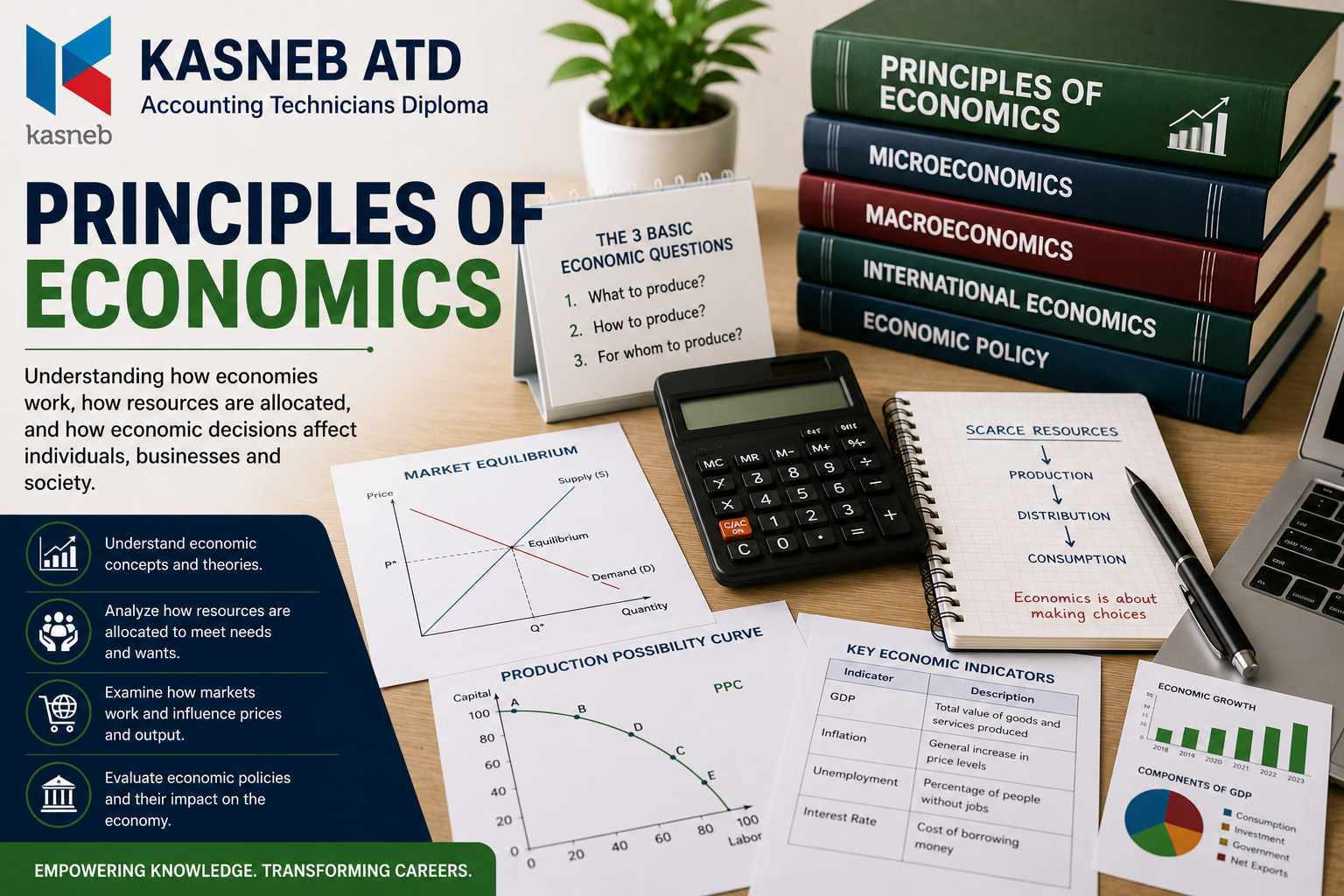
AD31: Principles of Economics is an Intermediate Level paper in the KASNEB Accounting Technician Diploma (ATD) qualification. It equips learners with the fundamental knowledge and analytical skills required to understand how individuals, businesses, and governments make economic decisions regarding the allocation of scarce resources. The course covers both microeconomics and macroeconomics, emphasizing the application of economic principles to business, public policy, and everyday decision-making.
Key Topics Covered
- Introduction to economics
- Definition of economics
- Basic economic concepts: economic resources, human wants, scarcity and choice, opportunity cost, production possibility curves/frontiers.
- Scope of economics: Micro and macro economics
- Methodology of economics: positive and normative economics, scientific methods, economics as a social science.
- Economic systems: free market economy, planned economy and mixed economy, consumers’ sovereignty and its limitations
- Demand, supply and determination of equilibrium
- Demand analysis
- Definition
- Individual demand versus market demand
- Factors influencing demand
- Exceptional demand curves
- Types of demand
- Movement along and shifts of demand curves
- Elasticity of demand
- Types of elasticity: price, income and cross elasticity
- Measurement of elasticity; point and arc elasticity
- Factors influencing elasticity of demand
- Application of elasticity of demand in management and economic policy decision making
- Supply analysis
- Definition
- Individual versus market supply
- Factors influencing supply
- Movements along and shifts of supply curves
- Definition of elasticity of supply
- Price elasticity of supply
- Factors influencing elasticity of supply
- Application of elasticity of supply in management and economic policy decision making
- Determination of equilibrium
- Interaction of supply and demand, equilibrium price and quantity
- Mathematical approach to equilibrium analysis
- Stable versus unstable equilibrium
- Effects of shifts in demand and supply on market equilibrium
- Price controls
- Reasons for price fluctuations in agriculture
- Government’s action to stabilise the prices and incomes of agricultural producers
- The theory of consumer behaviour
- Approaches to the theory of consumer behaviour - cardinal versus ordinal approach
- Utility analysis, marginal utility (MU), law of diminishing marginal utility (DMU)
- Limitations of cardinal approach
- Indifference curve analysis; indifference curves, budget lines
- Consumer equilibrium; effects of changes in prices and incomes on consumer equilibrium
- Derivation of a demand curve
- Applications of indifference curve analysis: substitution effect and income effect for a normal good, inferior good and a giffen good; derivation of the Engels curve
- Consumer surplus/ Marshallian surplus
- The theory of a firm
- The theory of production
- Factors of production
- Mobility of factors of production
- Short run analysis
- Total product, average and marginal products
- Stages in production and the law of variable proportions/ the law of diminishing returns
- Long run analysis
- Isoquant and isocost lines
- The concept of producer equilibrium and firm’s expansion curve
- Law of returns to scale
- Demand and supply of factors of production
- Wage determination theories
- Trade unions: functions and challenges
- Producer surplus/economic rent/ Marshallian surplus
- Quasi rent
- The theory of costs
- Opportunity costs ,explicit and implicit costs, private and social costs
- Short run costs analysis and size of the firm’s total cost, fixed cost, average cost, variable costs and marginal cost
- Long run costs analysis
- Optimal size of a firm
- Economies and dis-economies of scale
- Internal and external business growth
- Market structures
- Definition of a market
- Necessary and sufficient conditions for profit maximisation
- Mathematical approach to profit maximisation
- Output, prices and efficiency of: perfect competition, monopoly, monopolistic competition, oligopolistic competition
- National income, economic growth, money and banking
- National income
- Definition of national income
- Circular flow of income
- Methods/approaches to measuring national income
- Concepts of national income: gross domestic product (GDP), gross national product (GNP) and net national product (NNP), net national income (NNI) at market price and factor cost, disposable income
- Difficulties in measuring national income
- Uses of income statistics
- Analysis of consumption, saving and investment and their interaction in a simple economic model
- Determination of equilibrium national income
- Inflationary and deflationary gaps
- The multiplier and accelerator concepts
- Business cycles/cyclical fluctuations
- Economic growth, economic development and economic planning
- The differences between economic growth and economic development
- Actual and potential growth
- The benefits and costs of economic growth
- Determinants of economic development
- Common characteristics of developing countries
- Role of agriculture and industry in economic development
- Obstacles to economic development
- The need for development planning
- Short term, medium term and long term planning tools
- Challenges to economic planning in developing countries
- Money and banking
- Money
- The nature and functions of money
- Demand and supply of money
- Theories of demand for money: The quantity theory, the Keynesian liquidity preference theory
- The banking system
- Definition of commercial banks
- The role of commercial banks and non-banking financial institutions in the economy
- Credit creation
- Definition of central bank
- The role of the central bank; traditional and changing roles in a liberalised economy, such as financial sector reform, exchange rate reform
- Monetary policy, definition, objectives, instruments and limitations
- Determination of interest rates and their effects on the level of investment, output, inflation and employment
- Harmonisation of fiscal and monetary policies
- Simple IS–LM Model
- Partial equilibrium and general equilibrium
- Inflation and unemployment
- Inflation
- Definition and types of inflation
- Causes of inflation: cost push and demand pull
- Effects of inflation
- Measures to control inflation
- Unemployment
- Definition of unemployment
- Types and causes of unemployment
- Control measures of unemployment
- Relationship between unemployment and inflation: the Phillips
- curve
- International trade and finance
- Definition of International trade
- Theory of absolute advantage and comparative advantage
- World trade organisation (WTO) and concerns of developing countries
- Protection in international trade
- Regional integration organisations, commodity agreements and the relevance to less developed countries (LDCs)
- Terms of trade, balance of trade, balance of payments (causes and methods of correcting deficits in balance of payments), exchange rates, types of foreign exchange regimes, factors influencing exchange rates, foreign exchange reserves
- International financial institutions: International Monetary Fund (IMF) and World Bank
- National debt management: causes and interventions
- Structural Adjustment Programmes (SAPs) and their impacts on the LDCs
- Emerging issues and trends
Want to submit a review? Login